Just in time (JIT) is a method where a business only buys or makes materials, parts or products at the moment they’re needed. Not before, not after. The aim is to hold as little stock as possible without bringing work to a halt.
It comes down to three things: the right product, in the right quantity, at the right time. Get one of those wrong and you create waste. A delivery that arrives too early becomes stock that takes up space and ties up cash. One that arrives too late stops production in its tracks.
That’s why JIT treats stock as waste rather than a safety net. A full warehouse feels reassuring. But that stock is money sitting idle, it takes up space and it can go out of date or get damaged.
A simple example makes this clearer. A kitchen manufacturer working to JIT doesn’t keep a pile of worktops in stock. Only when a customer orders a kitchen does the order for parts go out to suppliers. They deliver on the day assembly starts. A few days later, the kitchen is with the customer and nothing is left on the shelf.
Just in time is more than a way of managing stock. It’s a way of looking at the whole process, from purchasing and production through to delivery. That’s why it sits within lean: an approach built around cutting waste and delivering value to the customer.
Just in time comes from Japan. Toyota developed it in the years after the Second World War, when the country was short of raw materials, space and capital. Holding large amounts of stock, as American carmakers did, simply wasn’t an option.
Kiichiro Toyoda, founder of Toyota Motor Corporation, was already using the phrase in the 1930s. It was Taiichi Ohno who turned it into a system that actually worked. As a production manager, he spent years from the late 1940s onwards building what would become the Toyota Production System.
Part of Ohno’s inspiration came from the American supermarket. A shopper takes a product off the shelf. The store then restocks only what has gone. Ohno brought that idea to the factory floor. Each production step collects parts from the step before it. That step then only makes enough to replace what was taken.
JIT didn’t really catch on outside Japan until the 1970s and 1980s. After the 1973 oil crisis, Toyota weathered the storm far better than most of its rivals. Western companies wanted to know how, and their research eventually gave rise to the term lean.
Just in time only works when every part of the process is in sync. Four building blocks make that possible.
A traditional factory produces to a forecast. You make what you expect to sell and push it down the chain. That’s known as push. If the forecast is wrong, you’re left with stock nobody wants.
Just in time turns this around. Customer demand pulls the product through the chain. Each step only makes something when the next step asks for it. That’s known as pull.
The difference lies in where it all starts. With push, it starts with the plan. With pull, it starts with the customer.
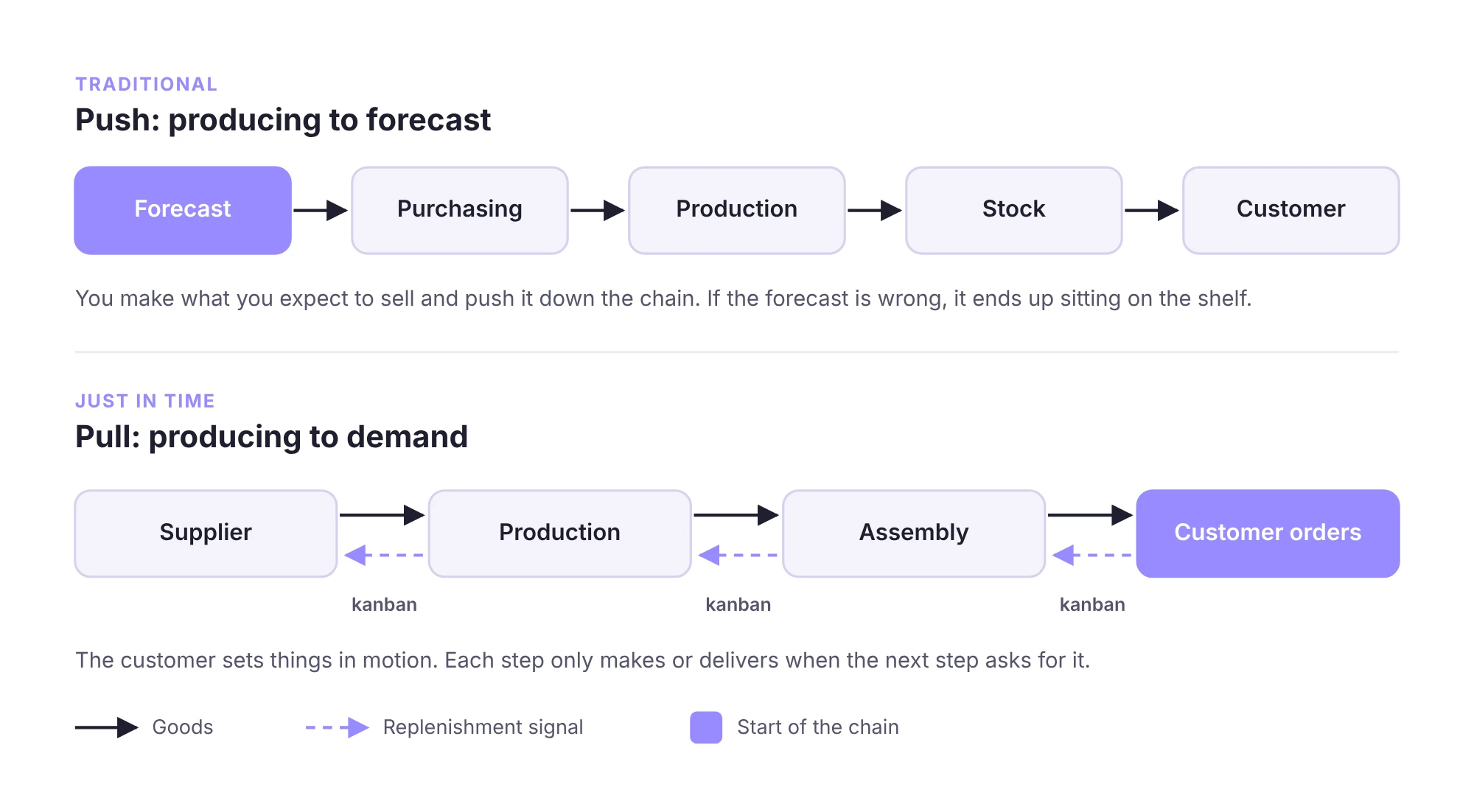
Pull only works if everyone knows when something is needed. That’s where kanban comes in. The Japanese word means card or signal.
In its classic form, every container of parts has a card attached. When the container is empty, the card goes back to the previous step or to the supplier. That card is the instruction: make or deliver exactly this amount. No card, no production.
Many businesses now use digital kanban. A scanner or system sends the signal as soon as stock drops below a set level. The principle stays the same: replace what has been used and nothing more.
JIT works in small quantities. Rather than a full lorry once a month, you might get a small delivery every day. That keeps stock levels low.
Small batches do come at a cost. Every order takes time and every delivery means transport. Traditional stock management therefore works out an ideal order quantity that balances ordering costs against storage costs. If ordering is expensive, it pays to order in bulk.
JIT tackles this from the other side. Instead of accepting large orders as a given, you make ordering itself cheaper. Think fixed agreements with suppliers, automatic ordering through kanban and a regular collection round across several suppliers, known as a milk run. The same goes for changeover times on the factory floor. If a machine can be switched over in minutes rather than hours, a small batch suddenly becomes worthwhile.
Back to the kitchen manufacturer. Here’s how an order moves through the chain in six steps:
A customer orders a kitchen in the showroom. The order goes straight into the system.
The system works out which parts are needed: cabinets, doors, a worktop and appliances.
For any parts not already on site, an order goes out to the suppliers, each with a fixed delivery date.
The suppliers deliver on the day assembly begins. Not a week earlier.
The cabinets go through production, the worktop is cut to size and everything comes together at assembly.
The kitchen goes to the customer. Nothing is left behind in the warehouse.
Small parts such as hinges and screws are kept in stock. They’re cheap, take up little space and are always needed. They’re topped up through kanban: when a container runs empty, a new order goes out automatically. That’s often what JIT looks like in practice. Rather than applying one rule to everything, you choose the smartest approach for each part.
Just in time doesn’t stand on its own. It’s one of the building blocks of lean, the wider approach that grew out of the Toyota Production System.
Toyota often explained its approach using the image of a house. The roof is the goal: the best quality, the lowest cost and the shortest lead time. That roof rests on two pillars.
The first pillar is just in time. The second is jidoka: stopping the moment something goes wrong, so a defect doesn’t travel further down the line. The two keep each other in check. JIT brings speed and low stock. Jidoka makes sure that speed doesn’t come at the expense of quality.
Beneath the house lies the foundation. This includes levelled scheduling (heijunka), standardised work and continuous improvement (kaizen). Without that foundation, neither pillar can stand.
Lean is all about eliminating waste, or muda in Japanese. Toyota identifies seven types:
Overproduction: making more than needed, or making it sooner than needed.
Waiting: people or machines standing idle.
Transport: moving materials around unnecessarily.
Overprocessing: doing more than the customer asks for.
Inventory: materials sitting around waiting.
Motion: unnecessary walking, searching or reaching.
Defects: work that has to be redone or is rejected.
Overproduction is seen as the worst of the lot. Make too much and you trigger the other types of waste straight away: extra stock, extra transport and extra storage. Just in time goes straight to the root of this by only making what there is demand for.
Lean thinking often uses the image of a river. The water is your stock. The rocks on the riverbed are your problems: a machine that keeps breaking down, a supplier who’s always late, a step where mistakes keep creeping in.
When the water is high, the boat sails on without a hitch. You can’t see the rocks. When the water drops, they come to the surface and you run into them.
Stock works the same way. A large buffer hides problems. Take that buffer away and you can see straight away where the process is getting stuck. That can feel uncomfortable at first. But that’s exactly the point, because you can only fix a problem you can see.
JIT isn’t something you can switch on overnight. It only works when a few conditions are in place.
JIT works best when demand is fairly predictable. Sharp peaks and troughs are hard to absorb without stock. That’s why Toyota spreads production as evenly as possible across the days, an approach known as heijunka. Better to make a little of everything each day than only model A one week and only model B the next.
Without stock, you depend on your suppliers. If they deliver a day late, your production stops. JIT therefore calls for close collaboration: clear agreements, short lines of communication and often suppliers located nearby. Many businesses work with fewer suppliers but build longer-term relationships with each of them.
With JIT, there’s no spare. Every part that comes in has to be right first time. If a delivery is rejected, there’s nothing to fall back on. That’s why quality is checked at the source, not just at the end.
People on the shop floor are the first to spot problems. In a JIT environment, they’re expected to flag them. Sometimes they’re even allowed to stop the line. That only works in a culture where raising a problem is welcomed, not punished.
JIT is never finished. Every time stock levels drop a little further, a new problem surfaces. You fix it, then look for the next one. This approach of small, steady steps is called kaizen. It’s not a project with an end date, but a way of working.
When it’s done well, just in time can bring a business a lot. These are the main benefits:
Lower stock costs: less money is tied up in stock and you need less storage space.
Less waste: products don’t go out of date or spoil on the shelf.
Shorter lead times: small batches move through the process faster.
Better quality: defects are spotted sooner and fixed at the source.
More flexibility: you’re not tied to a large stockpile, so you can respond faster to what customers want.
A clearer view of the process: without a buffer, you can see exactly where things get stuck.
Those benefits come with clear risks. The biggest is relying on a supply chain with no buffer. These are the drawbacks to bear in mind:
Vulnerable to disruption: a strike, a natural disaster or a blocked shipping route can bring production to a standstill.
Dependent on suppliers: if one supplier fails, your own deliveries take a direct hit.
Difficult with unpredictable demand: you can’t absorb a sudden spike without stock.
Higher transport and ordering costs: small, frequent deliveries mean more trips and more admin.
No margin for error: a rejected delivery means an immediate standstill.
A long road to implementation: JIT calls for new processes, new agreements and a new culture. That takes years, not weeks.
Major disruptions to global trade show time and again how fragile a tight supply chain can be. As a result, many businesses are deliberately building buffers back in for parts that are hard to replace. Which brings us to just in case.
Just in case is the counterpart to just in time. You deliberately hold stock, just in case. That buffer absorbs spikes in demand and late deliveries.
This table puts the two side by side:
Just in time | Just in case | |
Starting point | Make and deliver what’s needed | Hold stock just in case |
Stock | As low as possible | A deliberate buffer |
Costs | Low stock costs, higher transport costs | High stock costs, fewer orders |
Risk when disrupted | High | Low |
Works best with | Predictable demand and reliable suppliers | Unpredictable demand and long lead times |
In practice, few businesses choose one or the other. They combine the two. Cheap parts that are easy to source are managed just in time. For critical parts with long lead times, you keep a buffer. That way you keep stock costs down without a single late delivery bringing everything to a halt.
Just in time was born in the factory, but the principle works well beyond it. It found its way into software development through lean software development, an approach that applies lean thinking to building software. The core idea is the same: only build what’s needed.
A dev team doesn’t have a warehouse, but it does have stock: unfinished work. Features that are built but not yet live. Code waiting for review. That work takes time, delivers nothing yet and goes stale.
A kanban board helps keep this in check. Each column is a step in the process, such as build, test and release. A WIP limit (work in progress) sets how many tasks can sit in a column at once. When a column is full, nobody picks up anything new. Something has to move on to the next step first. That way the team pulls work through the process rather than letting it pile up.
Specifications can become stock too. A team that writes everything out in detail months in advance often finds that half of it no longer fits by the time they get to it. The customer wants something different, or the market has moved on.
That’s why many teams only flesh out a task just before they start on it, for example during refinement ahead of a new sprint. The same thinking sits behind YAGNI: you aren’t gonna need it. Don’t build a feature because it might come in handy one day. Build it when there’s real demand for it.
In the factory, JIT goes hand in hand with small batches. In software, that’s the idea behind continuous delivery: small changes that go live often, rather than one big release each quarter. A small change is easier to test. If something goes wrong, it’s quicker to roll back. And just like in the factory, problems come to light sooner.
Search for JIT in an IT context and you’ll also come across just-in-time compilation. That’s something else entirely. A JIT compiler converts code into machine code while the program is running, rather than beforehand. The idea of “only at the moment it’s needed” is the same, but otherwise it has nothing to do with the method in this article.
Just in time doesn’t work equally well everywhere. It’s best suited to businesses with predictable demand, a repeatable process and suppliers close by. Think of these sectors:
Assembly and manufacturing: such as cars, machinery and furniture.
Construction: materials go straight to the site, where storage space is often tight.
Hospitality and supermarkets: fresh products spoil quickly, so keeping stock low cuts waste.
Software teams: they apply the principle to work rather than physical stock, as covered above.
JIT is less suited to businesses with erratic or highly seasonal demand. The same goes for businesses with suppliers far away or parts with long lead times. There, the risk of downtime often outweighs the savings on stock. A mix of just in time and just in case is usually the more sensible choice.
Just in time is often summed up as “no stock”. That’s an oversimplification. It’s really about timing: the right product, in the right quantity, at the right time.
That takes more than simply ordering less. Stable planning, reliable suppliers, consistent quality and a team that feels free to raise problems all matter just as much. Without that foundation, JIT is more likely to become a risk than a saving.
Done well, it brings lower costs, less waste and a process that keeps getting better. On the factory floor, in the warehouse and in the dev team.
JIT stands for just in time. It’s a method where a business only buys or makes materials and products at the moment they’re needed. The aim is to keep stock as low as possible without bringing work to a halt.
Lean is a broad approach to cutting waste and delivering value to the customer. Just in time is one part of it. It’s one of the two pillars of the lean house, alongside jidoka.
No. Just in time is the principle: make what’s needed, when it’s needed. Kanban is the signal that makes it happen in practice. In software development, kanban is also a method for visualising work on a board.
Because there’s no buffer. If a supplier delivers late or a link in the chain breaks, production stops straight away. That’s why many businesses combine JIT with a small stock of critical parts.
Just in case. With this approach, you deliberately hold stock to absorb spikes in demand and late deliveries. It’s safer, but it costs more money and space.
By only picking up work when there’s capacity for it, for example with a kanban board and WIP limits. You also refine tasks just before you start on them and release in small steps. That stops unfinished work from piling up.